
As business analysts we often find ourselves operating in various contexts. Whilst there is a generally understood sequence of events in the typical software development lifecycle, we are often required to adapt to the delivery method within a project team or at a client. There is increasing focus on Dev(Sec)Ops which expanded stands for development, security and operations – an application practice that is essentially centered around continuous improvement, ownership and transparency. A simple google search on Dev(Sec)Ops will yield many a result around how a software engineer can approach Dev(Sec)Ops, but what about us as business analysts?
At a high level, the Dev(Sec)Ops cycle comprises a continuous cycle with the following phases:
- Plan: Where you can define project goals, requirements, and timelines to establish a clear roadmap for development.
- Code: In this phase, if you can, you may write some code but generally the software engineers in the team would write and manage source code using version control systems to ensure collaboration and maintainability
- Build: The source code is compiled into executable artifacts, automating the build process to ensure consistency.
- Test: Quality assurance engineering team members would execute automated tests to validate the functionality, performance, and security of the application before release. In this phase, there are instances of manual testing, which in some cases can be done by business analysts or software engineers in the absence of dedicated QA team members
- Release: The delivery team prepares and packages the application for deployment, ensuring all necessary components are included and configured.
- Deploy: The application is moved to production or target environments, making it available for end-users while minimising downtime.
- Operate: This is where management and maintenance of the application in the production environment is done, ensuring it runs smoothly and efficiently.
- Monitor: Once in production, there is a need to continuously track application performance, user behaviour, and security events to identify issues and improve the overall system.
Throughout these phases, a business analyst can still show up and add value which is summarised in the infographic below:
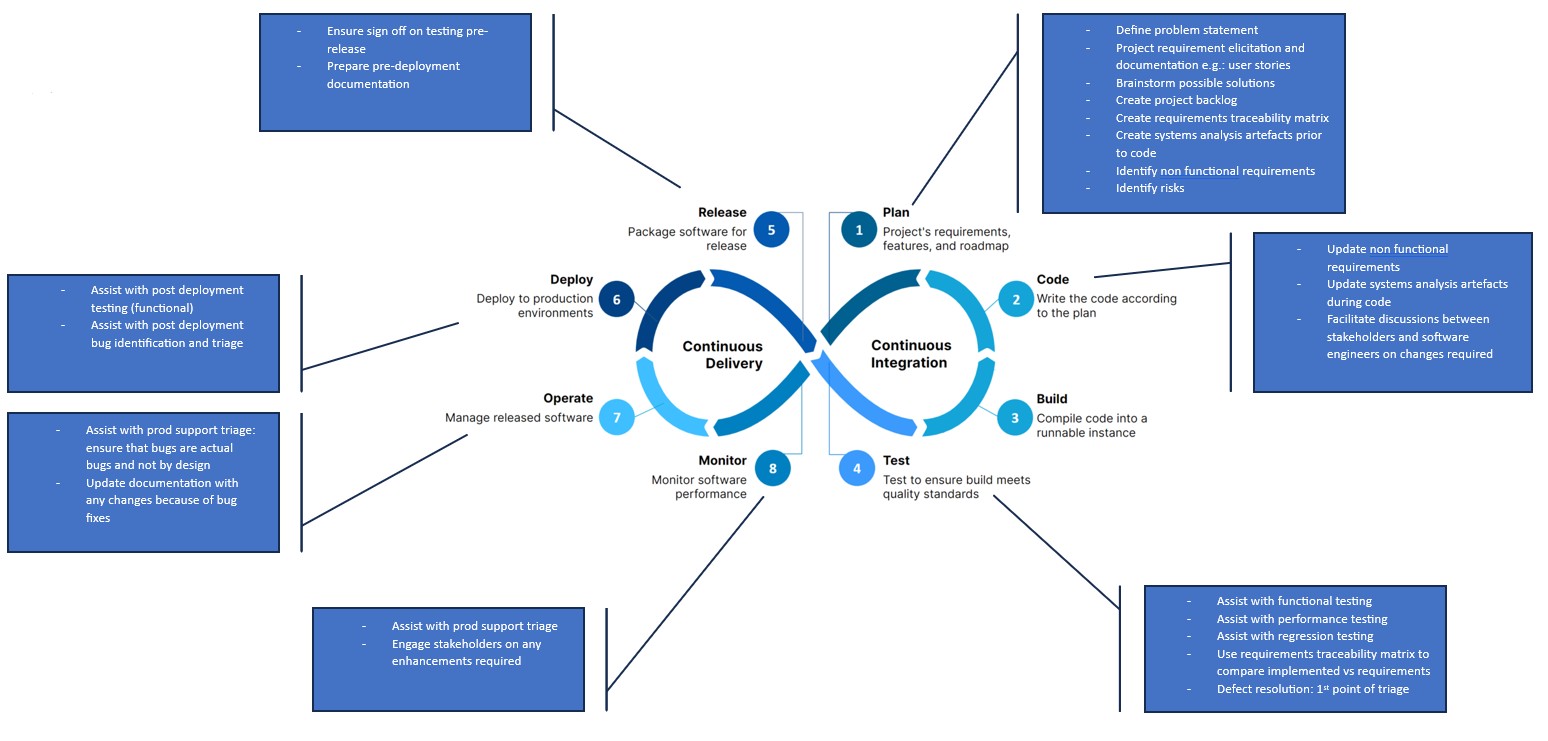
Adding value is something that can be done from the initiation of a project all the way through to post-implementation, with benefits such as a sense of equity in what is delivered to the client who ends up using the solution, team collaboration and cohesion and a decreased chance of rework as any deviations can be caught before they progress substantially.



 Analytically Speaking
Leave a comment